
Groundbreaking procedure offers potential new treatment options for pediatric cancer patients around the globe
INDIANAPOLIS (June 15, 2026) –Riley Children’s Health physicians at IU Health have performed the world’s first pediatric bone marrow stem cell transplant using cells from a deceased donor, a breakthrough that could dramatically expand access to life-saving treatment for children with aggressive blood cancers.
The procedure was performed at Riley Hospital for Children on 14-year-old Noah Britt, who was diagnosed with acute myeloid leukemia in August 2025. After Noah’s leukemia had a suboptimal response to chemotherapy, his physicians determined that a bone marrow transplant offered the best chance for survival.
In January 2026, he received a stem cell transplant using stem cells from a living donor registry, but the cells failed to engraft, and no additional suitable donor matches were available. Without a new donor, Noah would not survive.
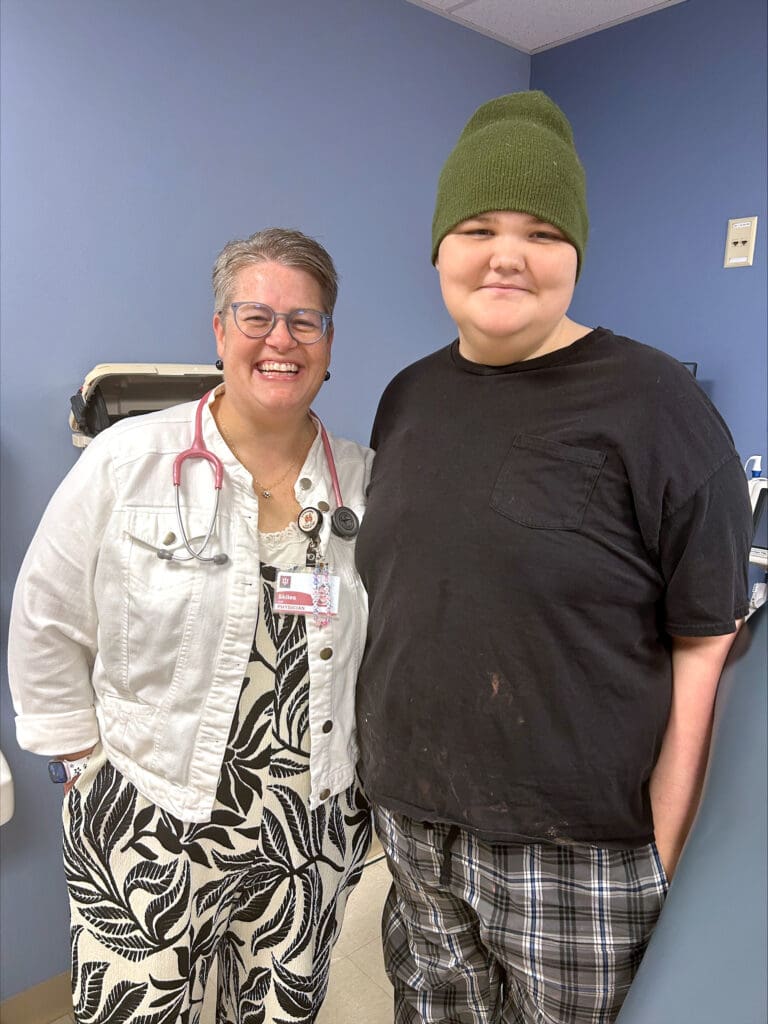
Dr. Jodi Skiles and Noah Britt
Facing limited options, Noah became the first pediatric patient in the world to receive a deceased donor bone marrow stem cell transplant through the HOPE Program, an expanded-access arm of the PRESERVE I clinical trial. The program provides cryopreserved hematopoietic progenitor cell (HPC) marrow to patients ages 12 to 80 who urgently need a transplant but are unable to find a suitable living donor match.
The transplant was completed in February 2026, marking the first successful use of the procedure in a pediatric patient. Noah is now in remission and continues follow-up care with his oncology team.
Each year, more than 18,000 Americans — including approximately 4,000 children — are diagnosed with blood cancers that may require a bone marrow transplant to survive. For patients with aggressive leukemia, the disease destroys the bone marrow’s ability to produce healthy blood cells, making timely treatment critical. Traditionally, stem cells are collected from a living compatible donor, typically a family member or a match identified through a national registry.
The opportunity to utilize banked deceased donor stem cells addresses one of the greatest barriers in bone marrow transplantation: finding a compatible donor quickly enough for patients who need a transplant urgently. Traditional donor searches can take months, and some patients never identify a suitable match.
The HOPE Program uses stem cell grafts recovered from previously consented deceased organ donors. The cells are cryopreserved and stored in a pre-banked inventory, allowing transplant centers to access them within days rather than months. Because the cells are immediately available, the approach may significantly reduce wait times and expand access to transplant for patients with otherwise limited treatment options.
To date, 28 patients worldwide have received transplants using this technology, with early peer-reviewed clinical data demonstrating rapid engraftment. Some patients begin producing healthy new blood cells in as little as 17 days.
“When Noah’s first transplant failed and he had no available living donor matches, we were facing a race against time,” said Dr. Jodi Skiles, medical director of Riley Children’s pediatric stem cell transplant program and associate professor of clinical pediatrics at Indiana University School of Medicine. “Because these stem cells are banked and ready to use, we were able to act in days instead of months. This treatment has the potential to dramatically expand access to transplant for children who previously had few or no remaining treatment options, giving us a way to close critical gaps in care and offer hope to families facing impossible circumstances”
Riley Children’s Health’s partnership with Indiana University School of Medicine, one of the nation’s leading medical schools, gives patients access to innovative treatments and therapies while advancing pediatric research and training the next generation of physicians.
For patients like Noah, this emerging treatment offers something that once seemed out of reach: another chance of survival when no living donor can be found.
Riley Children’s Health Feature Story: Deceased donor stem cells save teen’s life | Riley Children’s Health
Riley Children’s Health
Riley Children’s Health is Indiana’s only full service statewide pediatric health system. Riley Children’s offers complete, comprehensive pediatric care ranging from routine primary care checkups to the most complex acute care needs from highly skilled pediatric specialists. The system connects patients with expert primary care and specialty care physicians in communities across the state of Indiana. Riley physicians treat patients in their home communities, bringing top-notch care close to home. This statewide network is an extension of Riley Hospital for Children, one of the nation’s leading children’s hospitals consistently ranked a Best Children’s Hospital by U.S. News & World Report. rileychildrens.org